

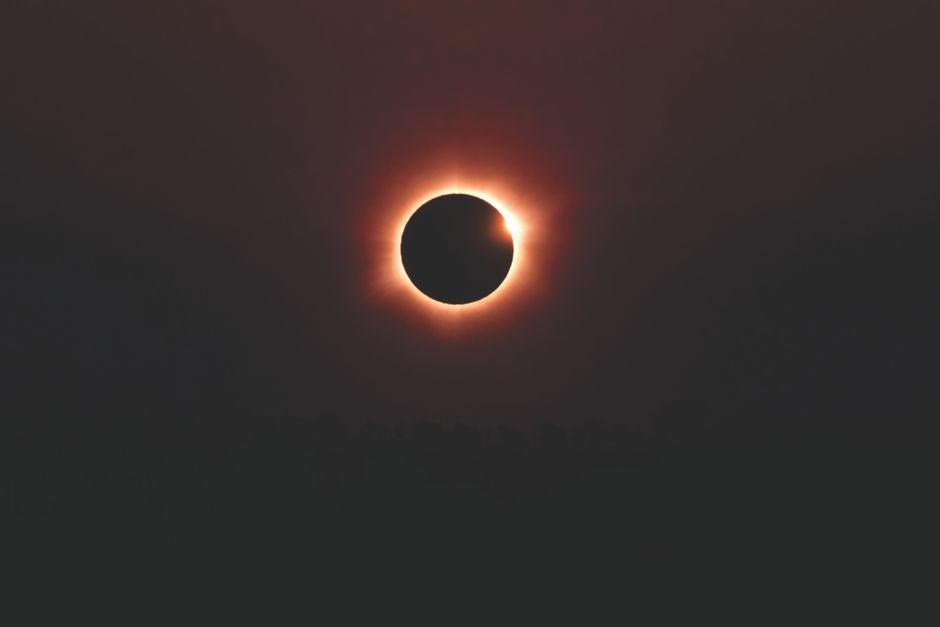
A total solar eclipse is expected to be observed in some parts of Bulgaria on August 12, with this country seeing it only in the far northwestern regions as a partial eclipse. A physicist explained that the phenomenon will be partial over a wider region, including the northern latitudes of the planet – from northern Russia to West Africa, while Europe will have varying viewing conditions.
Vidin serves as an example of the eclipse’s initial phase – it will begin at 20:27, when the Sun is only one degree above the horizon. The event will last briefly until sunset at 20:37, and the maximum obscuration depends on the height of the local horizon.
The strip of total eclipse will pass through the northernmost regions of Yakutia, cross the Arctic, follow the eastern coast of Greenland, and continue through the North Atlantic. Further on, the lunar shadow will pass over the northwestern part of Spain and end in the Mediterranean Sea. The total phase is expected to reach its greatest duration of 2 minutes and 18 seconds at 20:45 Bulgarian time in the North Atlantic.
For observers along the European coast, the best conditions for a total eclipse are expected on the northern coast of Spain around the cities of Oviedo, Ribadeo, and Navia. For an observer in the Oviedo area, the maximum phase is scheduled for 21:28, when the Sun above the western horizon will be at a height of about 10 degrees. The duration of the total phase from there will be about 1 minute and 48 seconds.
On August 28 there will be a partial lunar eclipse, which will also be observable in Bulgaria. The phenomenon will be visible from Central and Western Europe, West Africa, the Atlantic and parts of the Americas and the Pacific Ocean, as well as Antarctica. During the eclipse, the Moon will be in the Aquarius constellation, and the Sun in Leo. The total duration of the event will be about 5 hours and 38 minutes, beginning at 04:24 and ending at 10:02 Bulgarian time.
From Bulgaria, the event will be observable until the Moon sets at 06:31 in Varna and 06:51 in Sofia, when the sky will already be dim daylight. The maximum phase of the eclipse is expected around 07:13, when the Moon has entered Earth’s shadow by nearly 0.93 of its diameter. This is reported by BNT, which also emphasizes that observers in western countries will be able to see a more significant phase.
Source: Telenews
Comments
No comments yet. Be the first to comment!
Join the conversation
You need to register and confirm your email before writing comments.